
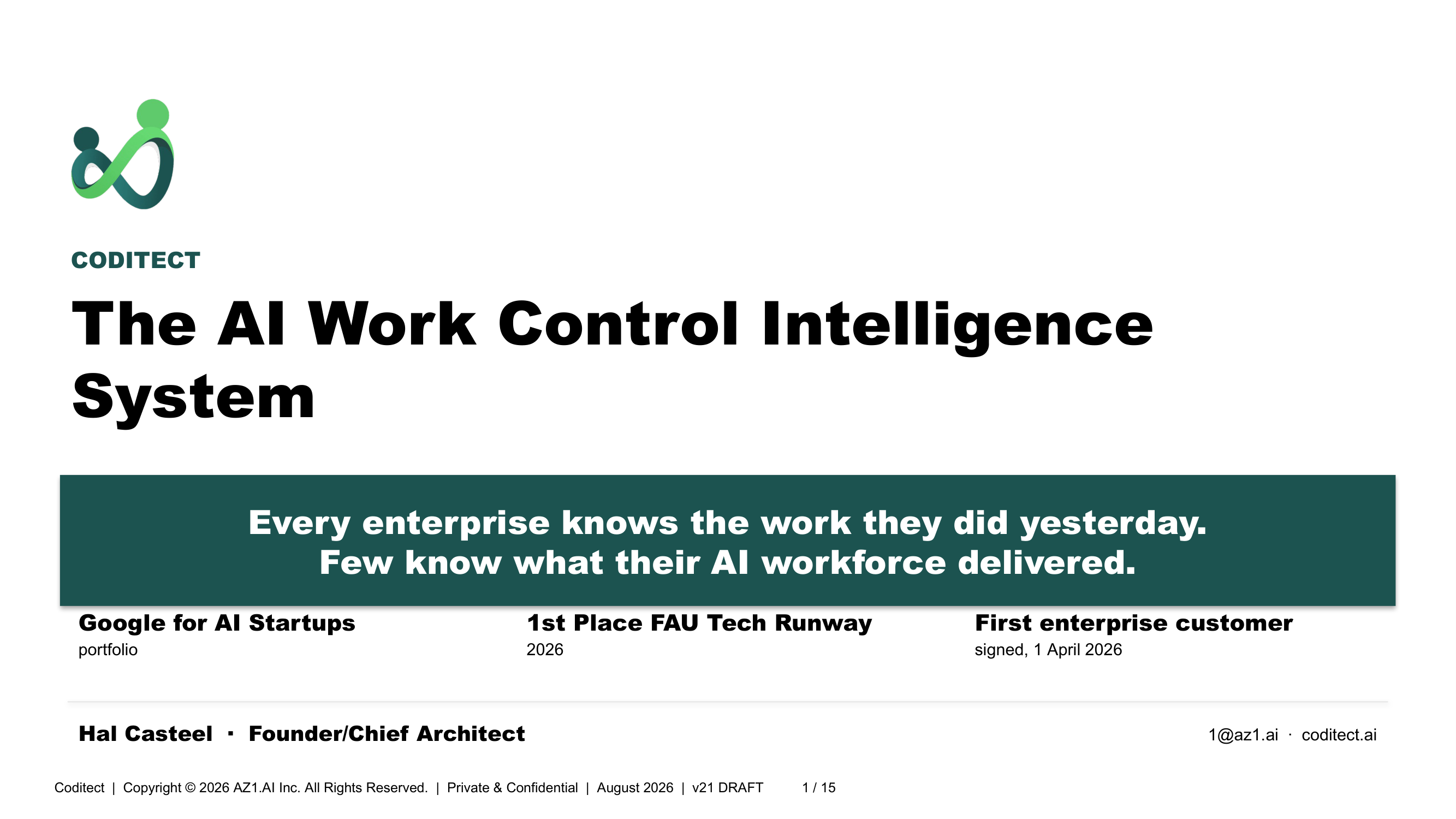
CODITECT Investor Deck v21 — Full Analysis
23 slides (15 core + 8 appendix). Evaluator: Matias Meirelles Van Vliet. August 2026.
Pre-seed deck for $3M raise. Bio-sciences/medical device beachhead, Canada-first jurisdiction.
Grade Distribution Across 23 Slides
4 Critical Missing Slides
These omissions may cost you meetings or second calls
1. Competitive Landscape (Core Deck)
No competition slide in the core 15. Appendix 3 has a competitive teardown, but investors need it in the main flow. CreatorIQ/Dome Systems/Credo AI/Arthur AI exist — not addressing competition signals naivete. The slide 7 differentiation framework is excellent — a direct comp slide showing where others sit in the Identity/Permissions/Activity/Judgment matrix would close the loop.
2. Revenue / Growth Chart
No revenue trajectory shown anywhere. Even at pre-seed with minimal revenue, show the growth curve: signed revenue, pipeline, LOI value over time. A chart going from $0 to $40K signed + $200K pipeline tells a story.
3. Customer Case Study
18 months in production with an enterprise customer and no case study slide. This is the strongest proof point. Show: problem the customer had, what Coditect did, measurable outcome. Even anonymized is fine.
4. Unit Economics / Financial Projections
No CAC, LTV, payback period, or 3-year pro forma. The per-action billing model is compelling but without projected economics, investors can't model returns.
Potential Investor Objections
| # | Objection | Severity | Deck Fix? |
|---|---|---|---|
| 1 | No competition slide in core deck — investors have seen AI governance pitches | Critical | Yes — move appendix 3 into core |
| 2 | Traction numbers too soft — "first enterprise customer" and "5 LOIs" need dollar amounts | High | Yes — add contract values, LOI ACVs |
| 3 | Team slide lacks credentials — no prior company logos or recognizable achievements | High | Yes — add one-line bios with company names |
| 4 | No revenue chart — can't assess trajectory | High | Yes — add signed + pipeline chart |
| 5 | Canada-first concerns — US VCs may see small market risk | Medium | Partial — add expansion narrative |
| 6 | No valuation on ask slide — investors can't model ownership | Medium | Yes — add cap/valuation |
| 7 | Business model pricing unclear — per-action but no $ per action shown | Medium | Yes — add example customer economics |
| 8 | No case study despite 18mo production — wasted social proof | Medium | Yes — add anonymized case study |
| 9 | Multiple buyer personas — CISO/CCO/VP Eng spreads the pitch thin | Low | Yes — pick primary buyer |
| 10 | Market sizing ranges — TAM $24.5-46B signals uncertainty | Low | Yes — pick midpoint, add bottom-up SOM |
9 of 10 issues are fixable with deck revisions alone.
The Canada-first concern may require strategic positioning rather than just a slide fix.
Immediate Fixes
Do these before the next investor meeting
Strategic Improvements
For the next deck revision
Bottom Line for Coditect
The deck has genuinely strong bones. The category-creation framing ("Every workforce got a system of record. AI didn't."), the differentiation slide ("Others watch the agent. We judge the work."), and the business model ("per AI action governed, not per seat") form one of the more compelling narratives I've reviewed this year. These three slides alone justify the meeting.
The core issue isn't vision — it's evidence. The traction slide is soft, the team slide underserves a team that grew from 2 to 11 volunteers in 6 weeks, and there's no revenue chart, no case study, and no competition slide despite having strong answers in the appendix. The appendix is doing heavy lifting that the core deck should be doing.
The fix is not to change the story — it's to prove it. A company that's 18 months in production, has governed 200+ agents, won a Google AI Accelerator slot, and attracted 11 people without paying them doesn't need to soften its claims. It needs to substantiate them. Lead with evidence. The narrative is already compelling.